WASA Lahore New Connection: Application Process, Documents, Fees & Requirements
If you are constructing a new house, buying a property, opening a commercial shop, or developing another property in Lahore, you may need a WASA Lahore water supply and sewerage connection.
A new WASA connection links the property with the municipal water-supply and sewerage network. The application normally involves submitting property and identity documents, a site inspection, payment of applicable connection charges, and technical installation work.
This guide explains the WASA Lahore new connection process, required documents, site inspection, demand notice, connection charges, unauthorized-connection restrictions, water metering, ownership transfer, and common questions.
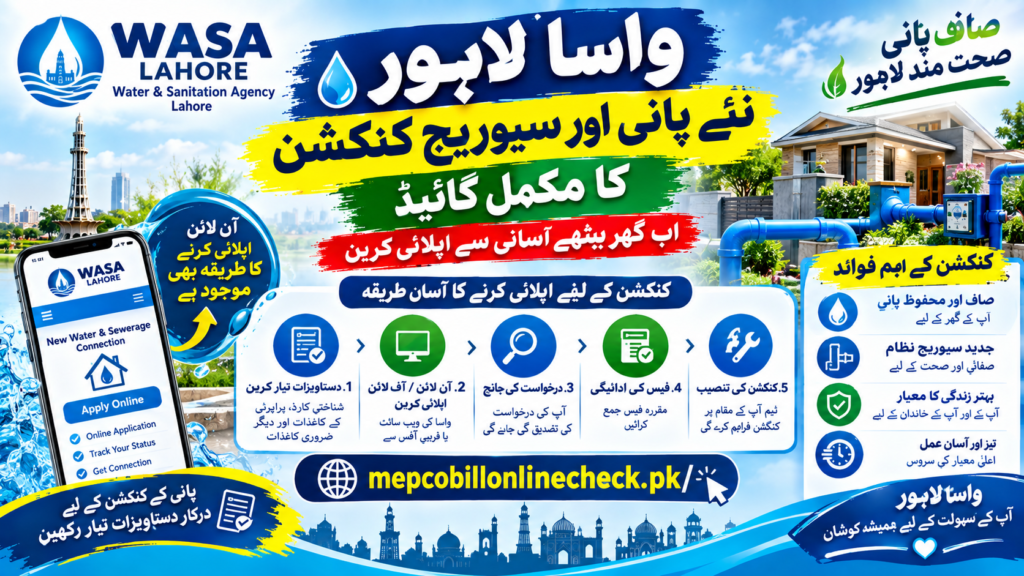
WASA Lahore New Connection: Quick Overview
| Requirement | General Information |
|---|---|
| Residential connection | For houses, apartments and residential properties |
| Commercial connection | For shops, plazas, offices and other commercial premises |
| Main application | Submit the relevant WASA application |
| Documents | CNIC, ownership proof, approved site plan and supporting documents |
| Site inspection | WASA field staff assess connection feasibility |
| Demand notice | Applicable charges are assessed after feasibility |
| Payment | Pay the prescribed amount through the designated channel |
| Installation | Technical staff carry out the approved connection work |
| Complaint helpline | 1334, according to the supplied source |
Important: Exact requirements, fees, connection sizes, payment channels and processing procedures can change. Applicants should confirm the latest requirements with WASA Lahore before submitting an application.
What Is WASA Lahore?
The Water and Sanitation Agency (WASA) Lahore is responsible for major municipal water-supply, sewerage and drainage services in Lahore.
Its infrastructure includes systems such as:
- Tubewells
- Water-supply pipelines
- Storage facilities
- Sewerage networks
- Drainage infrastructure
- Water meters where applicable
A formal municipal connection allows a property to be registered within the relevant utility system rather than relying on an unauthorized connection.
Types of WASA Lahore New Connections
WASA connections can generally be divided into residential and non-residential categories.
Residential Connections
Residential connections are intended for:
- Private houses
- Apartments
- Residential buildings
- Other eligible residential properties
The source material indicates that residential connection requirements and charges can vary according to property or plot size.
Commercial Connections
Commercial connections may apply to:
- Shops
- Plazas
- Offices
- Service stations
- Commercial buildings
- Industrial or other business premises
Commercial properties can have different technical and tariff requirements from residential properties.
Documents Required for a New WASA Connection
Prepare your documents before visiting the relevant WASA office or submitting an application.
| Document | Purpose |
|---|---|
| Applicant’s CNIC | Identity verification |
| Property ownership document | Establishes ownership or legal interest |
| Approved building/site plan | Helps verify the property’s approved layout |
| Neighboring WASA bill | May help identify the local water-supply network |
| NOC, where applicable | May be required for certain rented or shared properties |
The exact documentation can depend on the type of property and application.
CNIC Requirements
The source material states that the applicant should provide a clear copy of the Computerized National Identity Card (CNIC).
It also states that the copy should be attested according to the requirements mentioned in the source.
For overseas Pakistanis, the source mentions the use of NICOP along with passport credentials.
Because document-attestation rules can change, applicants should confirm the current requirement with the relevant WASA office before preparing the application.
Proof of Property Ownership
Your ownership documents should clearly establish your legal interest in the property.
The source lists examples such as:
- Registered Sale Deed
- Registry
- Fard-e-Malkiyat
- Allotment Letter
- Other recognized property-transfer documents
The source also mentions a recent Fard in its document-validation section.
If the property has recently been purchased, inherited, transferred, or allotted, take the relevant supporting documents with you.
Approved Building or Site Plan
An approved site plan can help WASA determine the property’s layout and connection requirements.
For larger buildings, plazas, or commercial developments, the source material says the approved plan may need to show relevant locations such as:
- Water storage tanks
- Pump rooms
- Plumbing shafts
- Other utility infrastructure
The plan should carry the required approval or sanction from the relevant authority where applicable.
Why Is a Neighbor’s WASA Bill Useful?
A neighboring WASA bill can help field staff identify the local utility network.
The source says it may assist with:
- Locating the nearby supply line
- Identifying the relevant consumer information
- Determining the applicable subdivision
- Supporting field verification
If available, take a copy of a nearby property’s recent WASA bill with your application documents.
WASA Lahore New Connection Process
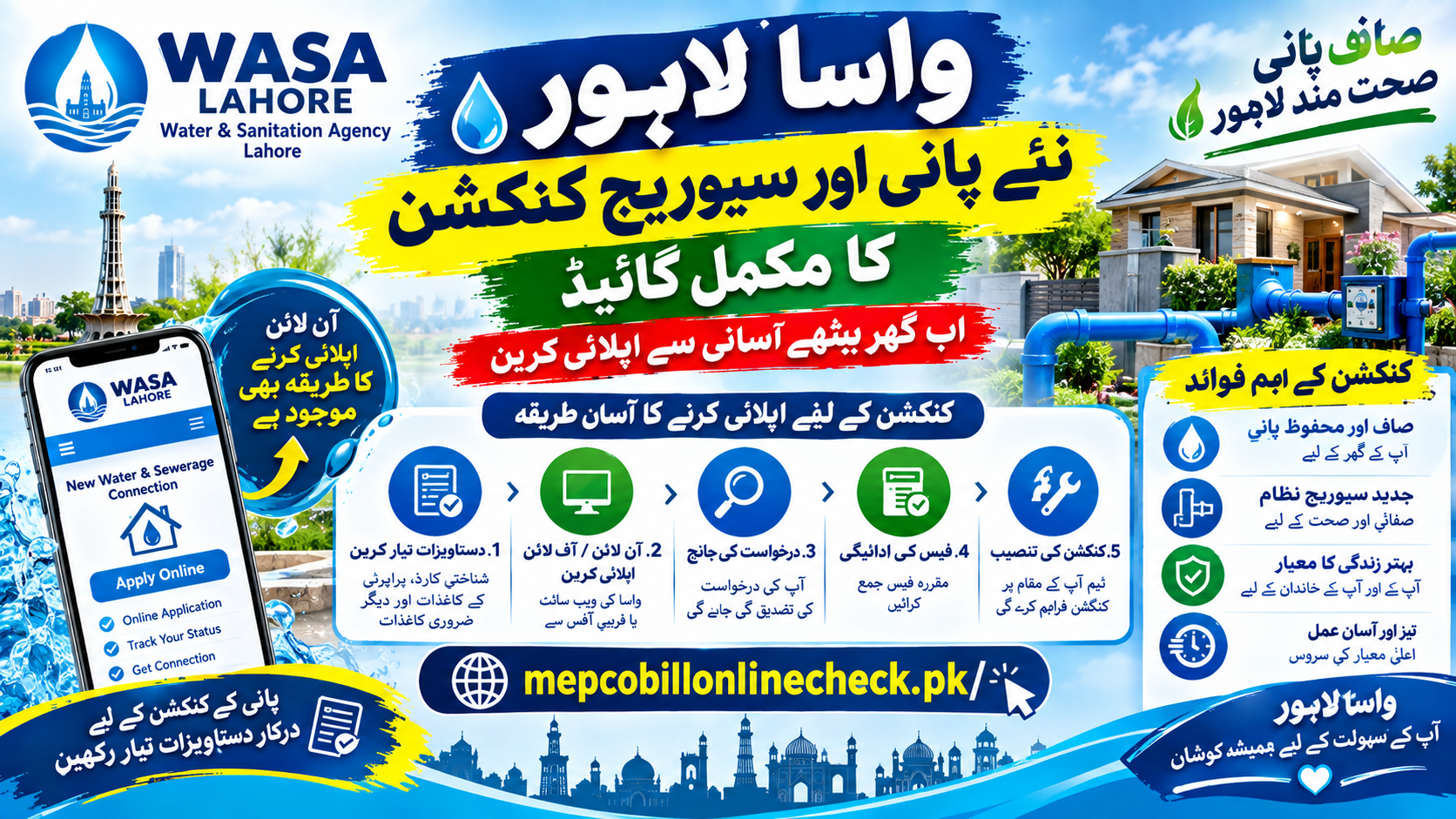
The application process described in the source can be summarized in four main stages:
Application → Site Inspection → Demand Notice & Payment → Technical Connection
Step 1: Get and Submit the Application Form
Obtain the appropriate WASA application form from the relevant service center or office.
The source material also states that the official form may be available through the WASA Lahore portal.
Complete the application carefully and provide information such as:
- Applicant’s name
- CNIC details
- Property address
- Plot size
- Covered area
- Required connection size
- Nature of use
- Residential/commercial classification
Double-check the information before submitting the form.
Step 2: WASA Site Inspection
After receiving the application, field staff may inspect the property.
The inspection can assess whether a municipal water main or sewer line is available and whether the proposed connection is technically feasible.
The field team may examine:
- Distance from the main line
- Street conditions
- Existing water infrastructure
- Sewer availability
- Required pipe length
- Road-cutting requirements
- Property access
This inspection helps determine the technical requirements of the proposed connection.
Step 3: Demand Notice and Connection Charges
After the feasibility assessment, WASA determines the applicable charges.
The source identifies possible components such as:
- Water connection charges
- Sewerage connection charges
- Security deposit
- Road restoration charges
- Other applicable administrative or technical charges
A Demand Notice or Bank Challan is then issued according to the applicable procedure.
The applicant should pay the amount through the payment channel specified by WASA and keep the original receipt or proof of payment.
Step 4: Technical Installation
Once the required payment and documentation have been verified, the relevant technical team can proceed with the approved connection work.
The source describes possible work including:
- Tapping the municipal supply line
- Installing connection valves
- Laying the connection pipe
- Connecting the property to the sewer network
- Installing a water meter where applicable
The exact work depends on the property, connection category and technical requirements.
WASA New Connection Fees
There is no single universal WASA Lahore new connection fee for every property.
The applicable amount can depend on factors such as:
- Residential or commercial classification
- Plot size
- Connection diameter
- Water-supply requirements
- Sewerage requirements
- Security deposit
- Road-cutting and restoration requirements
- Technical conditions at the property
General Fee Structure
The source provides the following broad structure rather than fixed rupee amounts:
| Property Category | Connection Size | Water Charges | Sewerage Charges | Security Deposit |
|---|---|---|---|---|
| Residential up to 5 Marla | 0.50 inch | Standard applicable tariff | Standard applicable tariff | Applicable deposit |
| Residential 5–10 Marla | 0.50–0.75 inch | Applicable tariff | Applicable tariff | Applicable deposit |
| Residential 10 Marla–1 Kanal | 0.75–1.00 inch | Applicable tariff | Applicable tariff | Applicable deposit |
| Residential above 1 Kanal | 1.00 inch or higher | Technical assessment | Technical assessment | Applicable deposit |
| Commercial shops/small plazas | 0.75–1.00 inch | Commercial charges | Commercial charges | Commercial deposit |
| Industrial/service stations | 1.50 inch or higher | Industrial charges | Industrial charges | Industrial deposit |
The source explicitly notes that exact monetary figures are updated periodically through applicable government and WASA notifications.
For this reason, applicants should obtain the current demand notice rather than relying on an old fee table found online.
Road Cutting and Restoration Charges
If a new connection requires excavation of a road or paved surface, additional costs may apply.
The source notes that road-restoration charges can vary according to the surface involved, such as:
- Asphalt
- Concrete
- Brick paving
The final amount should be confirmed during the official connection assessment.
How Long Does a WASA New Connection Take?
The supplied source describes the stages of application, inspection, payment and installation but does not provide a confirmed standard number of days for completing every new connection.
Processing time can depend on:
- Document verification
- Site inspection
- Availability of the municipal main
- Technical feasibility
- Payment of charges
- Road-cutting permissions
- Workload at the relevant subdivision
- Required connection work
Therefore, applicants should ask the relevant WASA office for the current expected processing time for their particular property.
Unauthorized WASA Connections
The source strongly emphasizes that unauthorized water or sewer connections can lead to enforcement action.
Examples mentioned include:
- Illegal water connections
- Unauthorized sewer connections
- Direct suction from municipal water mains
- Meter tampering
- Incorrect use classification
Potential Consequences
The source provides the following general examples:
| Violation | Action Mentioned in Source |
|---|---|
| Illegal water/sewer connection | Disconnection, recovery/billing and possible fine |
| Direct suction pump on main | Equipment confiscation and possible penalty |
| Commercial use on residential classification | Tariff conversion and possible backdated recovery |
Exact enforcement measures depend on the applicable rules and circumstances.
Why Direct Suction Pumps Can Be a Problem
The source warns against connecting an electric suction pump directly to a municipal water main.
Direct suction can create negative pressure in the supply line and potentially affect neighboring consumers.
A safer arrangement described in the source is:
WASA Main → Underground Storage Tank → Property Pump → Overhead Tank
The pump should draw water from the property’s storage tank rather than directly from the municipal main, subject to applicable WASA requirements.
Water Meter Tampering
The source also identifies tampering with water meters as a prohibited practice.
Examples include:
- Bypassing a meter
- Breaking meter seals
- Altering meter readings
- Interfering with metering equipment
The source states that penal recovery charges may be imposed for meter tampering.
Because the exact recovery formula can depend on the applicable regulations, consumers should not assume a specific penalty amount without checking the current WASA rules.
Industrial Waste and Sewerage Connections
Commercial and industrial properties have additional responsibilities when discharging wastewater into municipal sewerage systems.
The source specifically highlights concerns involving:
- Industrial effluent
- Commercial laundries
- Car-wash facilities
- Chemical waste
- Oil and grease
- Silt and other pollutants
Depending on the activity, appropriate treatment or oil-and-grease control measures may be required before wastewater enters the sewerage system.
Businesses should confirm the environmental and WASA requirements applicable to their particular operation.
WASA Water Metering
The source discusses the use of water metering as a way to measure actual consumption.
With a metered connection, charges can be based on volumetric water consumption where the applicable tariff structure provides for it.
Benefits of Metered Water Consumption
Metering can help consumers:
- Monitor actual water use
- Identify unusual increases in consumption
- Detect possible internal leaks
- Encourage conservation
- Better understand utility costs
Water Conservation Measures
Households and businesses can reduce unnecessary water consumption by:
- Installing faucet aerators
- Using flow restrictors
- Choosing efficient sanitary fixtures
- Using dual-flush toilets
- Avoiding unnecessary hose use
- Repairing leaking pipes and taps
- Monitoring monthly consumption
How to Transfer a WASA Connection to a New Owner
If you purchase an existing property, changing the WASA connection into the new owner’s name can help keep the utility record aligned with the property’s legal ownership.
The source describes the following general procedure.
Step 1: Obtain the Name-Change Form
Get the relevant application form from the appropriate WASA subdivision or available official online channel.
Step 2: Provide the New Owner’s CNIC
Submit the new owner’s identity document and the photographs requested under the applicable procedure.
Step 3: Submit Ownership-Transfer Proof
The source lists documents such as:
- Sale Deed
- Transfer Letter
- Inheritance Certificate
- Other legally recognized transfer documents
Step 4: Provide the Recent WASA Bill
A recent bill can help establish the account’s payment position.
The source recommends ensuring outstanding amounts have been settled before the transfer.
Step 5: Submit the Application
Submit the documents to the relevant WASA office for verification.
After the required checks and applicable payment, the connection record can be updated according to the official procedure.
What If There Is No WASA Water Main in Your Street?
If a municipal water main is not available near the property, a standard individual connection may not be immediately feasible.
Contact the relevant WASA subdivision to determine:
- Whether a main line is planned
- Whether an extension is technically possible
- What infrastructure would be required
- Whether additional permissions or charges apply
Do not arrange an unauthorized connection from a distant or private line.
What If There Is No Sewer Line Near the Property?
The same principle applies to sewerage.
WASA may need to assess whether an existing sewer line is accessible and whether a connection can technically be provided.
The site inspection is important because the availability and distance of the municipal sewer can affect the required work and charges.
WASA Lahore Complaint and Support
According to the supplied source, consumers can report issues through:
WASA Helpline: 1334
The source also mentions:
- Local Sub-Divisional Complaint Centers
- Punjab Citizen Portal
Common complaints can include:
- Low water pressure
- Water contamination
- Supply interruptions
- Billing issues
- Connection problems
- Other field-service concerns
When submitting a complaint, keep your WASA Account Code, property address, recent bill, and previous complaint reference available where applicable.
New WASA Connection Checklist
Before visiting the relevant office, use this checklist:
- Applicant’s CNIC copy
- Property ownership document
- Approved building/site plan
- Neighbor’s WASA bill, if available
- NOC, where required
- Correct property address
- Plot size and covered-area information
- Required connection size
- Nature of property use
- Contact/mobile number
- Copies of all submitted documents
- Payment receipt after the demand notice is issued
Frequently Asked Questions
How can I apply for a new WASA Lahore connection?
The source describes a process involving application submission, site inspection, issuance of a demand notice, payment of applicable charges, and technical installation.
What documents are required for a WASA connection?
The source lists a CNIC, property ownership proof, approved site plan, neighboring WASA bill, and an NOC where applicable.
Is a site inspection required?
The supplied process includes a field inspection to assess the availability of the municipal water and sewerage network and the technical feasibility of the proposed connection.
How much does a new WASA connection cost?
There is no single amount for every property. Charges depend on factors such as property category, plot size, connection size, sewerage requirements, security deposit and road-restoration requirements.
Can I use an old WASA fee table to estimate the current cost?
It is better not to rely on an old fee table. The source specifically states that monetary charges can be updated through official notifications.
What is a WASA Demand Notice?
A Demand Notice or Bank Challan is the official payment document issued after the applicable connection requirements and charges have been assessed.
Where do I pay the WASA connection charges?
The supplied source says payment is made through the designated bank or approved utility payment channels specified in the demand notice. Always follow the current payment instructions on your official notice.
Can I apply for a commercial WASA connection?
Yes, the source separately identifies commercial connections for shops, plazas, offices, service stations and other commercial or industrial properties.
Can I transfer a WASA connection after buying a property?
The source provides a name-change procedure involving the new owner’s CNIC, ownership-transfer documents, recent WASA bill and submission to the relevant office.
What happens if the previous owner’s WASA bill has unpaid dues?
The source recommends ensuring outstanding amounts are settled before transferring the connection. Confirm the account’s current status with WASA before completing the property transaction.
Is a direct suction pump allowed?
The supplied source warns against installing a direct suction pump on the municipal main line and recommends drawing water from an underground storage tank instead.
Why does WASA require a neighboring bill?
A neighboring bill can help field staff identify the local supply network and relevant consumer or subdivision information.
What happens if my property has no nearby water main?
Contact the relevant WASA subdivision for a feasibility assessment. The source does not establish a universal procedure or guaranteed extension for streets without an existing main.
What happens if my street has no sewer line?
WASA should assess the availability and feasibility of a sewer connection. The required work and charges may depend on the distance and local infrastructure.
Can I connect a commercial property using a residential connection?
The source warns against incorrect tariff classification and states that commercial use can result in tariff conversion and possible recovery of charges.
How can I reduce water consumption?
Use efficient fixtures, repair leaks, avoid unnecessary hose use, and monitor consumption where a metered connection is available.
How can I complain about low water pressure?
The source identifies WASA Helpline 1334, local complaint centers and the Punjab Citizen Portal as complaint channels.
Applying for a WASA Lahore new connection involves more than simply submitting a form. Applicants should prepare their identity and property documents, ensure the building plan is available, complete the site inspection, pay the official demand notice, and wait for the authorized technical connection work.
The exact WASA new connection fee, connection size, security deposit, road-restoration cost and other requirements can vary according to the property and current official schedule.
For this reason, avoid relying on unofficial fee lists or unauthorized agents. Use the latest information provided by WASA Lahore and keep copies of your application, demand notice, payment receipt and other supporting documents throughout the process.